From Actuals' perspective, an Actuals SFTP server is a secure file transfer server owned by Actuals, which allows the customer to periodically send files to Actuals.
This server is distinct from the External SFTP server, as it is managed and maintained by another organization, not by Actuals.
A common method sharing data with Actuals on a regular basis is to export data from your system into a file and uploading it to the Actuals SFTP server. (Secure File Transfer Protocol) serves as a reliable method for exchanging files between different systems. You can inquire about the feasibility of this exchange method with your internal IT department. Most departments possess the capability to create a script that creates automated exports and uploads them to the Actuals SFTP server.
To gain access to the Actuals SFTP server, please reach out to your implementation consultant, who will provide you with the necessary SFTP credentials.
Connecting to the SFTP server
Upon receiving the username and password from your Actuals implementation consultant, you will use these parameters to establish a connection to the SFTP server:
Server/Host:sftp.actuals.io
Username: Provided by your implementation consultant
Password: Provided by your implementation consultant
Port:22
Best practices
File format
When uploading files to the Actuals SFTP server, ensure that they are in the ‘.csv’ file format. If you require sharing files in a different format, please consult your implementation consultant for available options.
If you are able to determine the file names of the files shared with our platform we have some best practices:
Include the application from which the file was created (for example “CustomBackend”)
Include the type/table of the export (for example: “orders”)
Include the period of export date format ‘YYYY-MM-DD’A example clear file name would be “CustomBackend_orders_202X-01-01.csv”
Actuals provides an additional guide for sharing large CSV files. The guide can be found below.
Exchanging large datasets via compressed CSV files [GUIDE-4]
When sharing large files with Actuals, there are optimizations that can enhance the process compared to using uncompressed .csv formats. Utilizing compressed formats can significantly reduce data exchange times and storage requirements. Actuals supports various compressed CSV data formats. These compressed files can be unpacked by Actuals before being loaded into their system.
Benefits of Using Compressed Formats
Reduced Data Exchange Time: Compressed files are smaller in size, which means they can be transferred more quickly over the network.
Storage Efficiency: Compressed files take up less space, making them easier to store and manage.
Compatibility: Actuals can handle various compressed formats, ensuring flexibility in how you share your data.
Supported Compressed Formats
Actuals supports the following compressed formats for CSV files:
.csv.gz (Gzip)
.csv.zst (Zstandard)
.csv.zstd (Zstandard)
.csv.bz2 (Bzip2)
.csv.deflate (Deflate)
.csv.raw_deflate (Raw Deflate)
Steps
Compress Your CSV File: Use a compression tool to compress your CSV file into one of the supported formats.
Share the Compressed File: Once your file is compressed, share it with Actuals using the agreed-upon method (for example SFTP).
Unpacking by Actuals: Actuals will unpack compressed files in the formats listed above and load the data into the system.
ℹ️
Using a compressed format can reduce the file size with a factor 10 compared to an uncompressed format.
ℹ️
As a guideline, considering file compression becomes relevant when uncompressed files reach approximately 250 MB and are shared regularly.
Folder structure
Inside a SFTP server it is possible to create a folder structure. As a best practice we suggest creating separate folders for each different dataset. By Default you can use the naming convention “[Source Application Name] - [Dataset name]”.
For example if you provide order data from your backend and payment data from your backend we suggest to create two folders inside the SFTP server:
Backend - Orders
Backend_orders_202X-01-01.csv
Backend_orders_202X-01-02.csv
Backend - Payments
Backend_payments_202X-01-01.csv
Backend_payments_202X-01-02.csv
The manual for uploading a file to the Actuals SFTP server can be found below (click to expand).
Uploading a file to the Actuals SFTP server [GUIDE-5]
To upload a file to the Actuals SFTP server you two things:
An SFTP client. This is a program you install on your computer . An example is FileZilla.Please contact your internal IT department to install the FTP client recommended by your company.
SFTP credentials - you can request these at your Actuals Implementation Consultant.
This manual assumes use FileZilla to interact with the Actuals SFTP server .
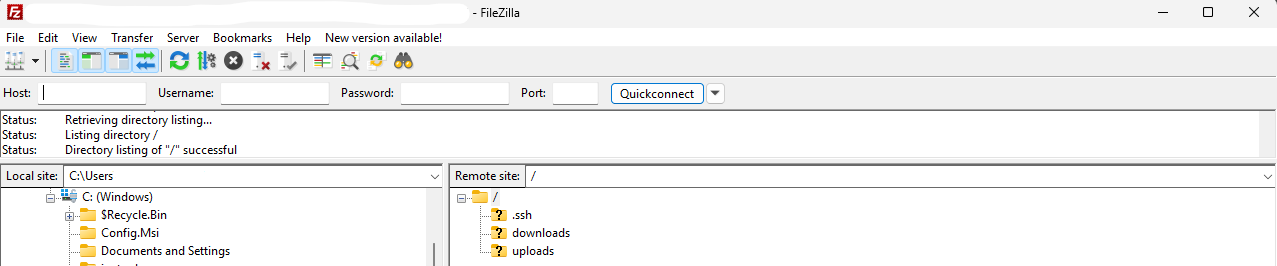
Launch FileZilla on your computer. Locate the QuickConnect bar, which is typically at the top of the main window, just below the toolbar.
Server/Host:sftp.actuals.io
Username: Provided by your implementation consultant
Password: Provided by your implementation consultant
Port:22
Click Quickconnect. You are now connected to the Actuals SFTP server.
You see a “local site” and “Remote site” section.
By dragging files from Local side to the Remote side you can Upload files.
At the bottom section you see the “Queued Files”, “Failed transfers” and “Successfull transfers” section. If you correctly uploaded files you will see the files appear on the “Remote side” and the task are also visible in the Sucessfull transfers section.
The FileZilla interface shows two sections:
• Local Site: Your computer’s files
• Remote Site: Files on the Actuals SFTP serverTo upload files:
Drag files from the Local Site to the Remote Site.
At the bottom of the window, you’ll see three tabs
Queued Files
Failed Transfers
Successful Transfers
When files are uploaded correctly:
• They appear in the Remote Site section.
• The transfer status is visible under Successful Transfers.